Showing posts with label group analysis. Show all posts

Tuesday, 20 November 2012

Group Analysis of The Usual Suspects


This clip is the start of the thriller The Usual Suspects, it does not include the credits which is a pan of the sea introducing the actors in the film.

The Usual Suspects is a crime thriller, written by Christopher McQuarrie and directed by Bryan Singer. The thriller which received 2 Oscars starred Stephen Baldwin and Kevin Spacey, the film includes a twisted storyline about a boat that was destroyed and the key to the mystery lies with the one survivor whose story leads to five crooks in a police line up.The conventions of a thriller are shown through the camera, editing, Mise-en-scene and sound to create tension and mystery.

Camera by Whole Group
In terms of camera, there is a frequent tilt involved to reveal an identity or a situation. For example when the fire is lit there is a slow tilt to establish the character on the boat urinating to prevent the fire from spreading any further. This presents a sense of mystery to the scene as the camera slowly reveals the body of the man but the tilt is cut just before the character's identity is shown. 
Between cuts there is a zoom in on the ropes which gives a sense of voyeurism as to the audience, it feels as though the scene is being watched.

Mise-en-Scene by Aimée
Mise-en-scene is used to portray the thriller conventions into the opening of The Usual Suspects by creating tension and mystery. The location of this opening scene is firstly shown by the camera by using a pan, it is the sea and the pan of the camera that shows the wide range of emptiness which establishes the setting. The sense of being alone in this scene makes the audience possibly feel tense as to why it the characters in the scene are alone and if them being alone will create danger. The location is established in the scene with editing showing a matched cut and the camera showing a zoom on ropes giving the impression that they are on a boat, supporting the credits of the sea. The props in this scene give a sense of the characters and the mystery of the opening scene. After the credits you are introduced to the scene by matches being lit for a cigarette in a line which was then dropped into some fuel, this creates a sense of danger for the audience as fire may be hard to control, we are then shown another fire source later on in the scene which is a gold lighter.This may create tension as to whether the lighter is going to be used to create fire but it also shows the wealth and power that that character has in contrast to the box of matches. This is a binary opposition possibly showing the protagonist v antagonist or weak v powerful, the use of binary opposition create a tradition convention for a thriller. The wealth of this character is extended by the used of camera showing a close up of a gold watch. A eye-catching prop used to create apprehension is the leaking oil barrel, after seeing the fire being created by the small matches makes the audience realize the possibility and danger that there may be a fire. In the scene you are shown various dead bodies firstly by the fire passing one man and the wealthy man walking past another with a gun indicating he is the antagonist, this constructs the sub-genre for this Thriller that it is crime and violence which are main conventions of a thriller.The lighting of the scene is very dark but the characters are shown through a reaction shot when the lighting up of a cigarette from the gold lighter is used revealing the face; again fire being a hazard.The lightening at the end of the scene is brighter to show the character and his importance when he is speaking to the investigators.

Editing by Anna
In the first 5 minutes of Usual Suspects, editing is used to emphasize the slow motion and detail in the scene. A slow cutting rate is identified to show the slow motion of the cigarette dropping to provide a tense feeling to the audience as they know it won't be a wise action to do. The slow motion is supported by the build up of sound which is known as a crescendo. This helps the audience to build up excitement for what's to come in the film as sound plays a big part in making people tense and eager. This is also supported with the slow cutting rate.
Near the end of the first 5 minutes, a zoom in on an area of ropes is shown to portray the sense to the audience that someone is watching the scene which is called voyeurism, commonly used in thrillers. After the camera zooms in on the ropes, editing is used to use the effect of dissolving to help hint to the audience that the next scene where the first character that speaks was the person watching through the ropes. The character in the next scene tells the audience the sense of the time and location when the previous scene occurred by saying: "It all started 6 weeks ago back in New York..."

Sound by Danny 

This thriller has the non diegetic sound of an orchestra playing over the petrol lighting. This gives the effect of tension because the orchestra playing feels like something big is going to happen with the sound bridge building up to something. At the very start the lighting of a match the diegetic sound is over emphasized to add more drama to the scene this builds the effect of that he will use that light to do something important. Also you can hear the diegetic sound of pouring before you see what he's pouring or what/who hes pouring on, this adds the effect of mystery it gets the audience asking themselves questions of why and who so builds the thriller effect of mystery. The non diegetic sound of footsteps does the same you only hear them first so they also build this effect. Also the loud volume of the explosion shows how epic the explosion was giving the effect nothing will be left.


Group Analysis of The Silence of the Lambs


The Silence of the Lambs is a 1991 American thriller that blends elements of the crime and horror genres. It was directed by Jonathan Demme and stars Jodie Foster, Anthony Hopkins, Ted Levine and Scott Glenn. It is based on the 1988 novel of the same name by Thomas Harris. In the film, Clarice Starling, a young FBI trainee, seeks the advice of the imprisoned Dr. Lector to apprehend another serial killer, known as "Buffalo Bill". The film involves hyped scenes and action to excite the audience.

Camera by Whole Group
The use of camera in The Silence of the Lambs can create intense scenes and suspense to portray the thriller conventions. At the beginning of the first 5 minutes of the film the camera sets the scene and identifies the character by using a tilt to show the hill Agent Starling is climbing up and slowly approaching the camera on, which makes the identity of the character clearer to the audience. Voyeurism is portrayed when the camera follows the female which makes the audience feel as if they are involved and chasing the character. This can also bring in a sense of mystery which is a thriller convention early on in the film by making the audience question why she is running. The camera helps show the personality of the protagonist as it shows a side shot of her face where she is gritting her teeth as if to show determination.
A zoom of the camera help establish the FBI building, which gives us a sense that this thriller will be related to a crime. The camera also zooms in on Clarice running which helps the audience to see her in context. Once in the office camera is used to show the reaction shot of the character when she see's the the shocking photos on the wall. After the reaction shot a point-of-view shot is shown to help the audience understand why she has reacted in the way she has and also tells the audience that the photos are an important aspect to the plot of the thriller.

Mise-en-scene by Anna
Mise en scene is used in the Silence of the Lambs to help establish the story line,  characters and location in the first 5 minutes of the film. The opening starts off in a known spooky location of a forest which gives out a eerie feeling to the audience and as forests are known to be spooky and mysterious, it links to how The Silence of the Lambs is shown as a thriller to the audience. The two ropes shown when Clarice Starling is running up the hill indicates to the audience that another person is meant to be running alongside her. This shows the determination the character has in the film and that she is possibly alone in the forest.
A medium shot is then shown to identify the character and what she does as on her jumper is says: "FBI Academy" which indicates her career and more information about the main character. The jumper she is wearing is sweaty which shows she is hard working and committed. The audience also soon know that the film involves mystery as a man runs after the woman, wearing a hat with capitals on the front reading: "FBI". The scene in the forest includes foggy weather and with the leaves on the ground establishes the season, Autumn. The foggy location is known to the audience as spine-chilling as it makes the audience aware that perhaps something might jump out or give out a sense of voyeurism. -This helps portray a thriller.
A long shot of the building establishes the FBI Academy and the people that work there are wearing different clothes which shows they are at work and gives a sense of mystery to the audience. When the main character is near the top of the building, she is surrounded by men in suits who are looking down upon her as if to say 'you don't belong here'. It shows the proxemics in this part of the building, especially in the lift where Clarice is the only female, the amount of men featured shows the dominance they have. Proxemics is also shown when Clarice is in the office as she looks like a schoolgirl who's noisy and interested in everything. A motivated cut is then used to help the audience get eager to know what she is staring in shock at. Once the cut to the photos on the wall is shown, this helps identify the plot to the audience as there are newspaper article headlining "BILL SKINS FIFTH" which tells the audience that the film will be gruesome with also the help from the photos shown. This helps establish that the silence of the lambs is a thriller as this genre usually has some gory scenes involved.   

Editing by Danny
Editing is used to portray a thriller during The Silence of the Lambs, when a match cut is used when the main character goes into a lift. This portrays a thriller because she goes into the lift last when its full, then is the last to come out. What this does is show the importance of the situation, that she has to go to the very top of the police building to talk over it. A motivated cut is used when you see the main characters face in reaction to what she has seen on the wall. This portrays a thriller because you see her face before you see what she's looking at so its not a normal reaction shot because it leaves you on a cliffhanger like a traditional thriller. A cut from the opening credits to the location is used to portray a thriller. It cuts to a very secluded location which is covered with fog. This links to a thriller because everything is hidden.

Sound by Aimée
The sound used in The Silence of the Lambs is used to create an immediate sense that it is a thriller and that the situation in the film is already untenable. In terms of sound the music plays a big part in the opening of this thriller by creating an eerie situation.The piece of music starts as high pitched then starts getting deeper and then becomes high pitched again. This music gives a tense suspense for the audience as the camera also works with it showing the forest but the mystery and suspense of not knowing what is going to happen. As we are introduced to the character when she is running the music starts getting faster, more mysterious and higher pitched, this builds the tension  and makes us think that she is running away from danger or possible unknowingly is approaching danger. The music is then stopped, but the music possibly being in that area of the scene shows that the setting itself there may be dangerous and that's why tension is created. When agent 
Starling is in the office the trill on the clarinet and music then starts again when she see's the crime wall with the deaths on it, this makes the audience tense as the same music was used in the forest making a slight indication that it may be linked. The diagetic sounds of the eagles squawking and the clear crisp sound of the leaves makes a tense situation as the character Agent Starling is alone which makes the audience uneasy. The sounds of the prison gates and gun shots creates a picture of crime and death which is a sub-genre and convention of a Thriller. Finally dialogue is used both to introduce the character and create anxiety. The character is approached by a man calling her "Agent Starling"; he is a higher rank than her as she answers "yes sir". This helps introduce the character and establish her role, Mise-en scene also helps support this. She is also seen panting and out of breath which bring ups the question of why? and if she is running from someone, if so who?


Group Analysis of The Da Vinci Code

How are the conventions of the thriller genre and the conventions of the film opening used in the Da Vinci Code?

The Da Vinci Code is a fast paced thriller where the main characters have to decipher clues in artwork, architecture and riddles to get to the bottom of a murder and save themselves. It is originally a novel written by Dan Brown but in 2006 was produced into a film. The film is directed by Ron Howard and the screenplay is written by Akiva Goldsman. The Da Vinci Code stars Tom Hanks, Audrey Tautou and Ian McKellen.

Camera by Whole Group
The use of camera in the opening scene creates a truly tense and mysterious opening scene for the Da Vinci Code. The use of camera was used to create a close up, this was of the paintings in Le Louvre; it was a close up of the peoples eyes that are present in the paintings.This is a traditional feature in a Thriller and it is used to create a sense of voyeurism like the characters are being watched which makes the audience tense that someone is around. Another way the camera creates tension and a sense of danger is using a hand held camera. This is used when the male staff is running through the gallery, this is used to represent his panic and makes the audience feel as if they may be running with him and part of this scene, this is also a way to make the scene more disrupted and uncomfortable. Following a character running through the scene can also show the setting, which gives the audience a greater understanding of where they are. Another thriller convention that was used in this opening scene was an extraordinary event in an ordinary setting. This is shown by an aerial view down onto the gallery roof as you see the male staff and the antagonist inside; the ordinary setting is also supported by the sound used. The sound used is diagetic of cars and general traffic in Paris. This creates a sense of mystery also as the conversation taking place in the gallery is not heard but the diagetic sound of traffic is in its place, the dialogue between the two characters is also an important piece of information which makes the audience want to watch on to know what was said and why it creates mystery and was not heard.
Mise-en-Scene by Aimée
The Mise-en-scene used in the first 5 minutes of The Da Vinci Code introduces us to characters, but not until the end of opening 5 minutes do we meet the Main Character. In the opening scene we see the antagonist chasing a museum manager. From costume we can tell that he is the antagonist as he is in a black cloak,which is a contrast to a normal suit as we see the manager in. We can also see he is the antagonist as of the props we see him using, a gun, which you usually link to death.The black cloak may be religion based which can also be linked to the props as what we see on the paintings around are ones of God and Jesus. The make up of the antagonist also makes it clear that he is bad as he is very pale with darkened eyes, compared to the manager.The location of the opening scene is at night in Le Louvre  Paris. This atmosphere of Le Louvre at night is eerie as it is a big empty place and they are alone, this is shown by the sound also as at the start we can hear the sound of the running footsteps linking this to the conventions of Thriller we can see that it is an extraordinary situation in an ordinary location, we can also tell that they are alone as the camera switches to an aerial shot of them in the building which also emphasises how big the place is an how alone they are.The props used in the scene are fitting to the location as it is Le Louvre but with a close up of the camera onto the eyes and faces of these paintings give a sense of voyeurism. The lighting of the scene also creates an eerie situation as it is dark and it makes you tense not knowing what is hidden and what may happen, but the lighting is to dark to know what is there. After the jump cut we can see that the contrast of lighting from the museum scene and how much lighter in the lecture hall it is which creates a very different scene but also drawing attention to the fact that the lighting is now focusing on another character, indicating his importance to the storyline. We are introduced to the Main Character by the props, the screen used behind the main character shows his name and also introduces us to the presentation he will be giving. The amount of people who came to his  lecture also makes us believe that he a very well known man in his profession.

Editing by Anna
Editing is used in the first 5 minutes of The Da Vinci Code to emphasise the important scenes to the audience. A fast cutting rate is frequently occurring at the beginning to show the shots of voyeurism from the paintings and the man running away from the antagonist. The fast cutting rate builds up the suspense as the camera also shows a variety of different shots of the protagonist which establishes the speed and the urgency within the scene. Voyeurism is shown through editing to indicate to the audience that the paintings in Le Louvre are perhaps watching them. This is shown through the cuts between the man running and the camera switching to show the eyes in the portraits. Throughout the beginning, the cutting rhythm is slightly in sync with the non diegetic sound. As the music changes pitch, a different perspective or view is shown. This creates a dramatic effect which links to how a thriller film is presented to the audience.
Themes of identity are shown through editing as reaction shots take place of the protagonist. The different cuts bounce around the protagonist running away from the antagonist which presents the protagonist's facial expressions through close ups of the camera. The reaction shots emphasise the urgency and energy needed to keep running at a fast pace which leads to an excited audience with the use of motivated cuts. The motivated cuts creates an intense atmosphere as the audience are eager to see what the antagonist looks like and who he is.
Cross cutting is used after the protagonist is shot to introduce another character to the audience and to create the sense that two scenes are happening at the same time which are somehow linked to one another. After the shooting, a cut is made to establish another scene. It shows a lecture happening and  the projector behind the speaker reveals the main character of the film, Robert Langdon (played by Tom Hanks). The scenes then cross cut between each other telling the audience that these scenes are an important aspect of the film.

Sound by Danny

Sound is used to portray a thriller at the very start of the film in the opening credits when the musical score is playing. The musical score builds in volume and pitch through out the opening credits and then both reach their peak when the title of the film is fully revealed. this portrays a thriller because as the volume and pitch are building so does the intensity making the movie have a tense feel from the start. This is then followed by a diagetic sound bridge from the credits to the opening scenes. This portrays a thriller because the footsteps that the audience hear are running, and without a picture on the screen, this then leads the audience to start to ask themselves questions. For example who is running? why are they being chased? who is chasing him? This all portrays a thriller because during a thriller questions are always running through an audiences head.

Group Analysis of Se7en


To the right is a clip showing the opening credits of Se7en. This is an analysed along with the first five minutes of the film.

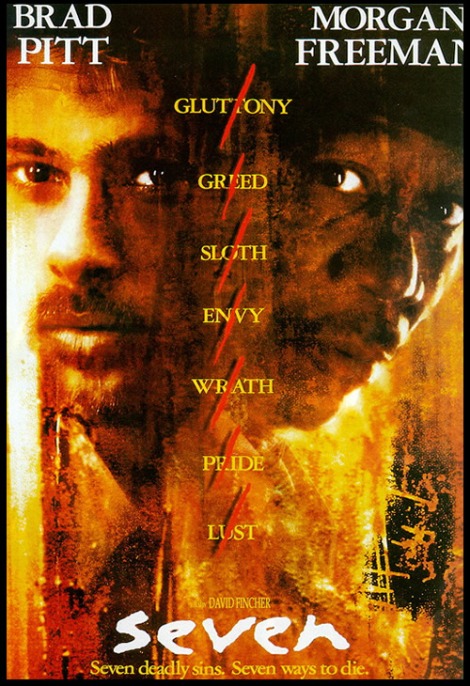
Se7en is a psychological thriller film with neo-noir and horror elements, written by Andrew Kevin Walker and directed by David Fincher. The Thriller is starring Brad Pitt and Morgan Freeman in which they play the role of homicide detectives. This thriller includes the use of Camera, Mise en scene, Editing and Sound to highlight the mystery and drama within this genre.

Camera by Whole Group
Throughout the opening of Se7en camera is used to highlight the conventions of a thriller and to introduce the characters. In terms of camera there is an over the shoulder shot of the main character, Detective Somerset. He is established in the mirror, this is supported by mise en scene as he is wearing a suit to emphasise the power and importance of his job. The camera then tilts to introduce his character to the audience. The knowledge of the character increases as the high angled close up of his equipment, for example his detective badge and a knife indicating he may have a dangerous job. The scene then cuts to his work place of the crime scene which involves a tilt of the camera to show the damage he has to face. This includes a dark, gloomy room and a dead man with a pool of blood surrounding him which makes the audience wonder what has happened in this scene and why this situation has occurred  This adds to the mystery of the genre early in the film.
During a low angled shot of the two detectives walking, the camera has a chance to show the audience the rough neighbourhood the two characters are working and living in. This area is portrayed as a dangerous, dirty and scary by the mise en scene and sound involved.
A mid shot of Detective Somerset in his bedroom is presented in the next scene to establish his lifestyle by showing the props in his bedroom.

Editing by Aimee
At the start of the opening scene we are introduced by one of the main characters getting ready for work, the editing used in this scene has a slow cutting rate, this makes the audience really watch what the character is doing. From this and the Mise-en-Scene you can see the use of props such as the chess board which implies that he is an intelligent but possibly lonely man, which also includes a use of Camera on his props to show that he is a detective and may need a knife for protection. The use of Editing gives the audience an insight into the importance of the main character for the film and the type of man he is. In terms of editing jump cuts are used to show the contrast of his home life and work life. For example when a jump cut was used between him getting ready for work in a calm environment to him at work at a crime scene this may increase the tension and suspense of the thriller as it is a shock and a big contrast for the audience to see a crime scene already in the film, it is used again to show the rough neighbourhood where him and his work partner are talking, the jumping to Detective Somerset in bed. There is an increased cutting rate when the detective is in bed and the metronome is ticking. The use of Editing and Sound in this makes the audience feel on edge as it is repeated many times and you don't know what is going to happen and why the Detective is reacting and blocking out what is around him. The cutting rate on the opening credits is fast and last only a couple of seconds. The editing used for the opening credits matches the thriller genre by making the audience question what is going on and feel tense that they don't know. The use of cutting keeps the scene fast paced which therefore builds tension throughout, the use of Sound is also a factor in the opening credits as the music is  speeding up when this is happening, building on the tension and suspense even more. A black background is often used to place and put emphasis on the credits, such as the actors names and the director, this is to show the well known actors in the film for the audience to see. The on-screen graphics are in a font that looks like it has been handwritten or scratched which is what the character we see in the credits has been doing. this matches well with the Mise-en-scene when we see the character making a type of scrapbook, which makes the audience already question what is happening, which thriller is set to do throughout a film. The font used for the credits are jagged and distorted which creates a creepy sinister like feel. The black background signifies darkness and death and mystery as it questions what is there, which relates to what the audience have seen in the Mise-en-scene of the film so far, when the man is dead on the floor of his apartment.

Mise-en-scene by Danny
Detective Somerset is shown taking all his police equipment in order and slowly at a close up angle, he also which shows the attention to detail he shows this again when taking off a tiny piece of fluff from his suit, this shows he's a detective who pays attention to detail this shows that he may notice key things that other characters will not in the thriller, making him a key character. Setting is used also to show the characteristics of the main character when his bedroom has only a single bed, which shows he is a lonely character this is added to by the chess board in the kitchen which he had been playing on his own.Setting is also used to represent the thriller as being set in a rough area this is shown by boarded and barred windows on the street this shows the people in those houses and shops dont feel safe without these. Also the crime-scene was in a dark dusky flat just on the street the lighting makes it seem very mysterious and puts across the classic feeling of a thriller. Costume is used to show the sub-genre of this thriller which is an American-crime-thriller. This is shown by the classic smart wear in which Detective Somerset is wearing, he wears a smart white shirt, black tie, braces, classic long coat and trilbie hat which are all stereo typical detective clothing.
During the credits lots of things involved with a crime scene where shown across the screen cutting from one to another very quickly to hide what is going on in the cuts. This gives across the effect that something is hidden because these are done in a close up shot to make a mystery effect. Props are again used to promote the genre when things relating to a crime scene are shown in the credits for example razor blades, crime scene pictures, crime notes, evidence and strands of hair.

Sound by Anna
   Sound plays a big part in the opening of the film, Se7en. It is evident through the incorporation and combination of sound elements such as music, dialogue, sound effects and silence that relate directly to the emotions presented visually. There are two types of sound techniques used at the beginning of the film, non-diegetic and diegetic sound. Non-diegetic sound is only used at the first opening 18 seconds of the film other than the opening credits later on. This is where the Distributors of the film's logo is shown, it is silence. However diegetic sound is shown through the dialogue and the sound of the objects the characters touch. Such as when the hero of the film, Detective Somerset (Morgan Freeman) is in the kitchen tidying up, you can hear as an audience the clash of the coffee jug and his mug being bundled into the sink to emphasise the neatness within the main character. Throughout that long shot of Detective Somerset in the kitchen, you can also hear background sound from outside in the streets such as, the beeping of car horns and shouting which helps identify the busy location he lives in. There is also a TV programme sounding in the background to perhaps show the relaxation he tries to savour in the morning.
   A change of scene is shown when the location of the detective's house switches to the crime scene. A police radio can be heard to represent the importance of the characters and how dangerous the scene is to the audience. Whilst the sounding of the police radio, the camera leads up the dead man surrounded by a pool of blood in which establishes the detective's job and what he has to face.  Use of dialogue is then portrayed from Detective Somerset: "Did the kid see it?". This quote shows that the detective pays attention to everything and makes the audience anxious as to whether the kid will appear at some point later in the film.
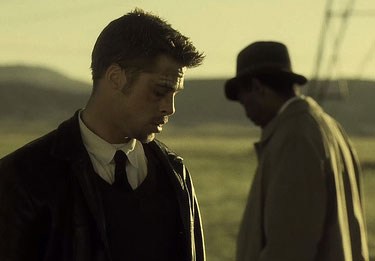
   Once introduced to Detective Mills (played by Brad Pitt), a cut is made to show the two detectives who will be working together, talking outside the crime scene. Sound and Mise En Scene both help identify what the rough neighbourhood is like. The scaffolding surrounding the detectives indicates that damage is always caused and the area is always being worked on or getting fixed. Whilst Detective Mills and Detective Somerset are walking down the road, the scene looks dark and gloomy and with the sound of rain pouring down, it gives a mysterious, sinister impression to the audience. This links to how a thriller is constructed and how a thriller can come across as spooky and eerie.
   Diegetic sound is used when Detective Somerset is lying in bed; sirens can be heard outside in the street and what sounds like fighting and shouting also. This tells the audience that a crime may happen every night. A close up of the metronome shows the Detective starting it up which builds up the suspense and tension within the scene. This constant, consistent ticking of the metronome leads subtly into the opening credits. An example of non-diegetic sound is featured here as a mix of unusual music can be heard to the audience. Sound effects and selective sound has been used here to create a 'screeching' effect. Constant sounds can be heard throughout it for instance, a siren, a heartbeat and an high pitched screaming effect can be heard now and again.